
The app you built with AI, live, secure, and ready for real users.
You built it in Replit, Bolt, Lovable, Cursor or Perplexity, and it works on your computer. Deploying it properly and securing it is a different job. I do that part, on cloud accounts in your name.
Tell me what you need built or fixed, and I'll tell you where I'd start.
Who this is for
Most clients come to me in one of two spots.
-
Your field has rules about records
You are a therapist, advisor, accountant or attorney, and your app holds records that have to be protected.
-
A deal is waiting on an answer
A customer or investor asked where your data lives and who can reach it.
Why it stops working - “It works on my computer” stops being enough.
Your app has to hold up when a customer sends you a security review.
A customer sends a security review
It asks about encryption, access and backups, and you have no written answers.
Nobody knows who can reach the data
Keys sit in the code, the database is open to the internet, and there is no record of who opened what.
The AI tool built the app. Deploying it, securing it and writing down how it runs is still somebody’s job.
Tell me what you need built or fixed, and I'll tell you where I'd start.
How I can help - Get it live, then keep it running.
You always own what gets built, and every deployment ends with a written handover so you and your team stay in control.
Secure Cloud Deployment
I move your app onto the right cloud platform, in an account in your name. Security-reviewed, configured, access controlled, with automated deployments and a written handover.
Deployment for records that must be protected
Everything above, plus encryption, a record of who reached what, tested backups, and a written record of the work. You also get a clear list of what stays on your side.
Keep your app running
Once your app is live, I keep it secure, updated and cost-efficient as you grow: fixes, feature work, a daily check on your app, and regular cloud cost reviews.
Live help while you build
Stuck mid-build in an AI tool? On a live video call I work through it with you, with plain-English answers and better prompts.
I also take on general software development: new builds, new features on an app you already have, modernizing older code, and cross-platform mobile apps with .NET MAUI. Software development →
Every engagement is quoted. Scope varies too much for a price list, and the only figure a list can honestly carry is the smallest job on it.
How an engagement works - Simple, clear, no surprises.
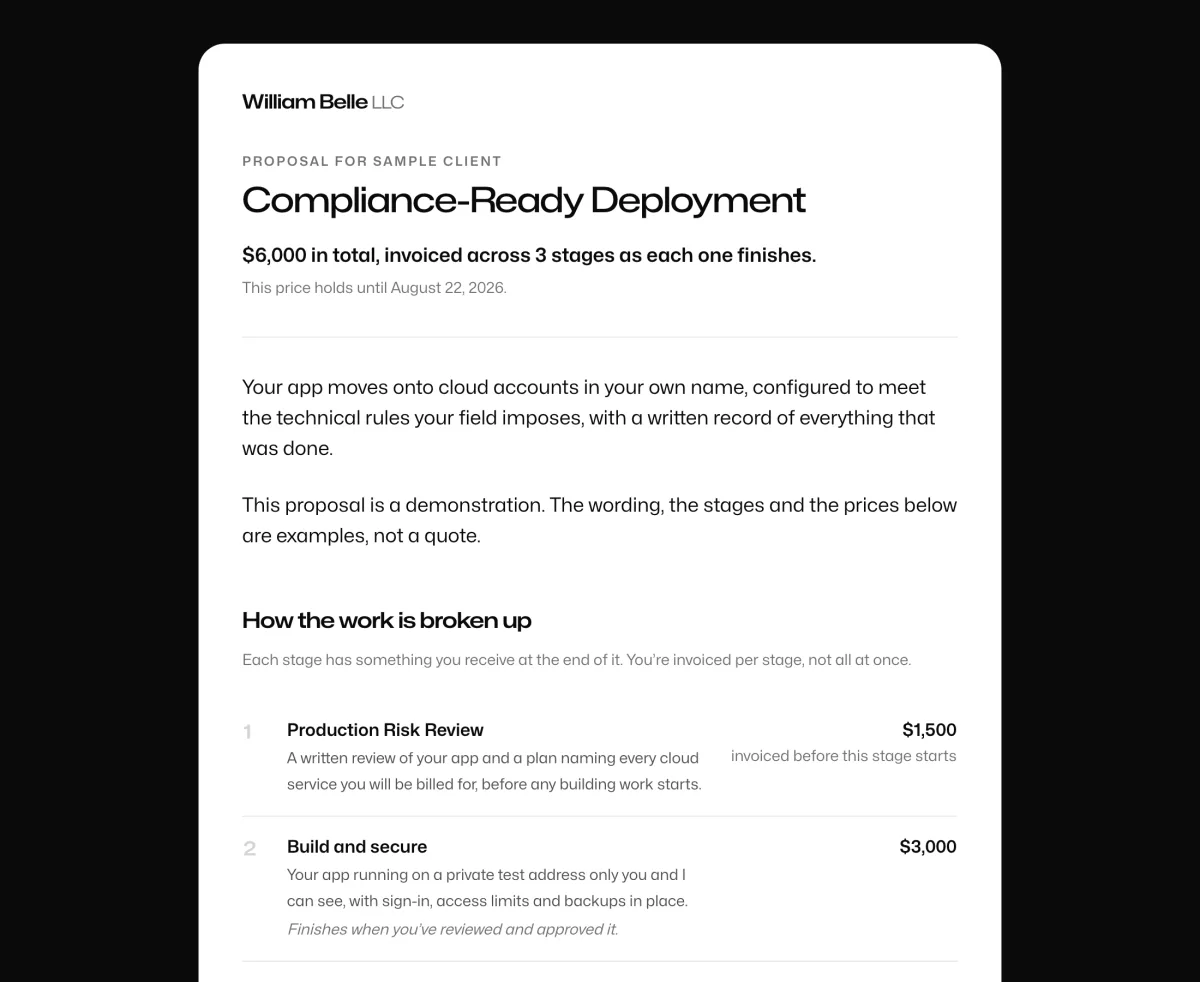
Four steps from your first message to work running in production: a free review, then milestones you approve and pay for one at a time.
Tell me what you need
Book the free review or send a message. You leave with a fixed quote and nothing owed.
I read what you have
The first milestone, billed up front. A written plan: what has to happen, what it will cost to run, and how long it takes. Quoting the rest blind is how a fixed fee turns into an argument.
I deploy and secure it
The middle milestones. The cloud setup, the security work, and any code changes it needs. You see it on a private test address only you and I can see before anything is live.
You get the keys
The last milestone. It goes live, and I hand over a written record of every account, password, and security setting, with a walkthrough. Everything runs in accounts you own, so nothing depends on me still being here.
Proof - Read the work before you talk to me.
Most consultants ask you to take the quality on trust until the invoice arrives. Here is the actual output, in public.
A real handover document
What a client receives at the end: every account, every setting, every decision and why it was made. Published in full, anonymized, so you can judge the standard of the writing before you hire the writing.
A recent project
A small practice had an internal application that worked and had never been deployed properly. I rebuilt how it runs: who can sign in, what each person can reach, and where the data sits, on Azure accounts in their name.
I finally feel like I actually own my app.
Software I run myself
UnityPay and Albie are on the App Store and Google Play, and I operate both: the releases, the infrastructure, the support address. Whatever I would ask you to run, I already run, and I hear about it when it breaks.
An engineer who starts from your business, not the code.
I’m Will, a software engineer with an MBA from The Ohio State University and the Microsoft Azure Developer Associate certification (AZ-204). Most of the work is translating between your business goal and the technical work. A project has gone well when it solves your problem, not when the code runs.
Azure, Terraform, Azure DevOps pipelines, C# and .NET, TypeScript, React, Python, SQL Server and PostgreSQL.
Learn more about meTwenty minutes, and nothing to prepare.
Tell me what you need built or fixed, and I'll tell you where I'd start.